
Christine Carolan, 13 July 2023
Christine Carolan is one inspiring woman. At 16 years of age, she made a commitment to work to address social injustice. For her, this was a duty of faith, which her Catholicism continues to motivate.
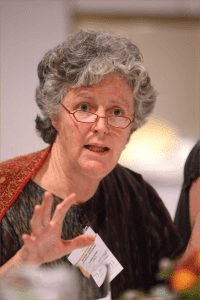
As a teenager, Christine felt that this calling might be lived out in a religious order. After school she prepared to enter, but her parents told her to get a degree first. So she studied and started to volunteer with the Uniting Church in a very poor school. Part way through, she took a year off to pursue social justice work in Indonesia. These experiences led to a different calling, in which her passion spread wider than the religious boundaries of her youth.
As a lay woman, wife and mother, Christine has found plenty of opportunities to share her faith, and the responsibilities of her faith, with others. With friends she formed a Eucharist Group that met monthly. They organised the Eucharist together, sharing this ministry with and for each other, although they didn’t always have a priest to preside. 50 years ago, an experience “still stays vividly in my head” of washing each others’ feet during Holy Week. She says, “It was such a gentle, nurturing thing to do for each other – especially if they were dirty. We then spent the time to dry them properly. That is what Jesus was calling us to do – to be in relationship.”
Christine has developed her faith and understanding in a number of ways, and studied biblical studies at university. She keeps looking for ways to minister, or – as she puts it – to be part of a ministry coalition or team. With a group of Mums, she created a Confirmation program for their soon-to-be-teens. It was “really important to think about what was important to us.” They came together to impart three main values: spirituality, community and commitment to social justice.
When Christine lived in the US for several years, she joined a women’s church group in the United Methodist Church. Then, back in Australia, for 20 years she has been involved in setting up bible study groups in her parish. Reflecting on the readings, especially during Advent or Lent, has been “really special, and a great springboard for ongoing reflection and action.”
Today, Christine embeds her ministry into her social justice work, even though it may involve many people of other faiths or no faith at all. She sees her role as ministering to the people who minister to those on the margins. Each meeting, they begin with an indigenous acknowledgement and then a reflection sharing a spiritual moment. Her values remain: “We affirm that we are spiritually connected, a community (willing to work through differences), and committed to building a socially just world.” Three times, she has been asked to give a homily during Mass. She feels like it was expected that she would present a social justice talk, but she can do much more than that. With her biblical studies, it was a real scriptural reflection that is now “my custom” on a social justice-focused Sunday. “Initially, when I was asked,” Christine says, “’I thought, no I don’t want to do that. But then I thought, if we as women want to move into respected roles in our church, we need to seize every opportunity, and we need to support each other’s efforts collegially.”
As a faith community, Christine feels that we are missing out on such perspectives. Young people are not drawing the dots between Catholicism and their passion for social justice: issues like homelessness, asylum seeking, the Voice and human trafficking. We don’t always have the energy needed to support and nourish young people, which leaves the Church bereft as well. Christine has run Children’s Liturgy many times, over many years, in her parish. And so many times she has apologised to the young girls: “’I am sorry that we adults have not changed things so that you cannot step into any role in our Church.’ I am not thinking those little girls would aspire to be a priest in a hierarchical church; I am thinking that the ministry that might open up to them is a collegial ministry, an empowering ministry, with a strong feminist voice.”
“It is up to us,” she says. Christine feels that as a faith community, we should be willing to support people, including financially, in ministry roles that are both ordained or not. She has been inspired by women ordained through other processes who are so excited to minister in poor areas with a clear role, ordination and an income.
Finally, Christine paints a beautiful picture of what is already possible. It was while she attended St Joseph’s in Collingwood, which was “a cross-section of Australian society, including many people on the margins.” A key person in the community was Margaret Oates, the ‘Angel of Collingwood’. When she died, a few women in the church “self-appointed ourselves to be crowd-managers, welcomers, ministering to those who didn’t know if they were welcome in the church.” They did not want the Catholics up the front and ‘the others’ at the back. So they guided everyone in, saying, “You’re welcome! Please feel free to join in as much of this service as you feel comfortable.” There was no need to apologise. Everyone felt welcome and included.
To register for our upcoming events: Retreat (1-3 September) or Webinar (3 September), please visit https://liturgyonthemargins.org/events/
 Liturgy on the Margins