
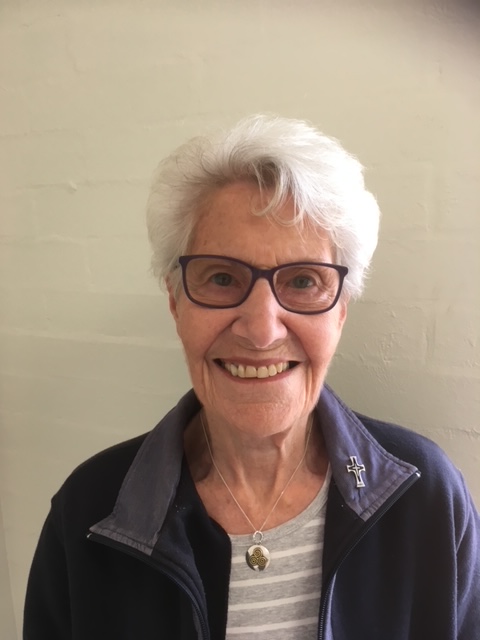
Sr Carmel Setford RSM, 9 May 2024
Carmel Setford RSM was a teacher and school principal for 37 Years. As Principal of Parish Primary Schools it meant automatic involvement in the parish and so it seemed a natural progression in 1997 to accept the position as Parish Leader in a small country parish, comprising of three small communities in the Mallee region of north eastern Victoria.
At that time there were four other parishes all within two to three hours travel where religious sisters were Parish Leaders. Along with the clergy from other northern parishes they met three or four times a year. Some of the priests from these parishes had been appointed by the Bishop to be Sacramental Ministers to those parishes who had a Parish Leader. This meant the Sacramental Ministers were responsible for celebrating Eucharist on a rostered basis once or twice a month and the other sacraments when necessary. The actual running of the parish, preparation of liturgies and sacraments, visitation and especially the involvement of parishioners in all areas of decision making concerning their small communities and the parish in general, was the role of the Parish Leader.
Initially, the Bishop requested that Carmel work towards “making the parish self-sufficient”. This was not a difficult request as the previous Parish Priest along with his role as Parish Priest had also worked in Ballarat four days each week as Pastoral Planning Officer for the Diocese. He had therefore done much of the ground work in his own parish. It was therefore a matter of continuing in the manner that he had established, which was for the parishioners to take control of their communities and parish.
Carmel very much believes in a church of the laity, so she found many ways to empower and encourage them in sharing their gifts and talents. There were no Catholic schools in the towns, and families had always taken the responsibility of passing on the faith to their children. By gathering the parents and the children who were to prepare for the Sacraments and discussing a suitable program to use in preparation, they usually agreed to meet on a regular basis to do the preparation together with the parents taking turns to lead the lessons. There were similar programs for preparation of Baptism and also helping families prepare Funerals. Weddings were less common and a Focus Program was one means of formation, but ultimately the celebrant was responsible for the preparation.
For Sunday liturgies, the priest was only available to come once or twice a month. The previous Parish Priest had set up a group of leaders with a format to be followed, so it was a matter of meeting with the leaders during the week prior to their turn for what was referred to as a ‘Lay-Led Assembly’. This meeting was mainly to reflect on the scripture readings in order to help in gathering some thoughts they could share with the gathered community. Together, they would break open the word of the week, aided by some prepared commentaries. At first, the leaders “baulked” at sharing their reflection at the time of the homily, but they found that silence wasn’t enough. Not everyone owned a missal so by supplying a printed copy of the readings with some reflective questions, everyone was able to focus on the readings and consider the questions. After the gospel, the leader would introduce a time of quiet reflection along with suitable music. The congregation were then invited to turn to those around them for some shared reflection. Then they had an opportunity to share in the larger group. Finally, the Liturgy Leaders would “round it up” with a sentence each of their own thoughts. They came up with some wonderful reflections which helped to encourage the congregation to live out their Christian calling in their daily lives.
After seven years, the time came for Carmel to leave the running of the parish in the parishioners’ capable hands. She hoped that they would be able to choose leaders from among themselves to act as contact persons for their particular community.
In each faith community, Carmel invited parishioners to name someone whom they considered as having leadership potential. Each nominated person was then invited to come together to decide on three persons from each place who would be prepared to act as contact people. Together they prayed to the Spirit for guidance in discerning God’s call to service within their faith community. Carmel encouraged them by pointing out that someone had seen each nominated person with some leadership potential or possessing qualities they admired.
From this session, the nominees decided that they didn’t like the term ‘leader’ but preferred to be known as ‘contact people’. Each person was informed, invited and prepared. In a Spirit-inspired process, the larger groups naturally whittled to 3 in Quambatook, 3 in Boort and 2 in Lalbert who were able to take on these roles. After Carmel left, they took it seriously and “went from strength to strength”. She heard that one of the men, a musician, prepared a “wonderful” DVD reflection for Social Justice Sunday.
However, not all Carmel’s dreams have come to fruition. She wishes that these models could have continued and grown. She sees permanent deacons – men and potentially women – as a “backwards step” as they take on roles that the lay people since Vatican ll have traditionally held. Rather, Carmel would like to return to the early Church and Vatican II for inspiration for new solutions to our current needs. Thanks, Carmel!
 Liturgy on the Margins