
Deacon Peter Pellicaan, 29 August 2024
Baptisms are a real opportunity to make people feel welcome in the church. In this time of declining faith involvement, Deacon Peter Pellicaan says to the parents of the children he’s baptising, “It is great that you are here; this is a gift that you are giving to your children.” He appreciates the journey it has taken to get there and understands their unique experiences of family and faith.
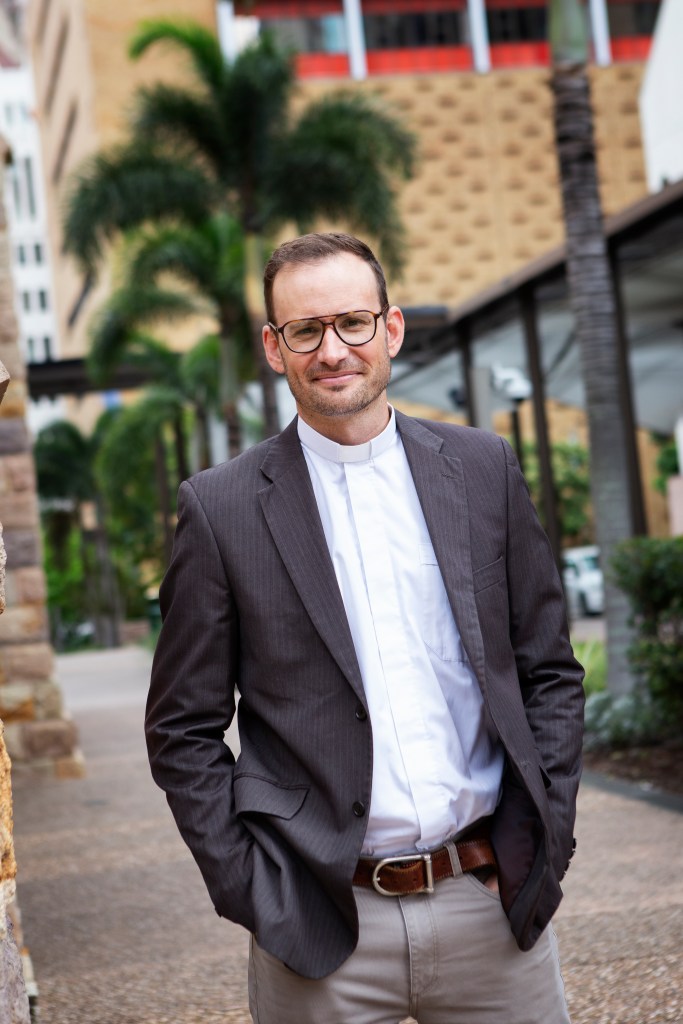
Peter certainly has an uncommon story. He was brought up the son of a minister, and grandson of a minister, in the Reformed Church. From the age of 14, he felt a “very clear” call to ministry, though that has taken various turns. A Christian Minister for 9 years, he was first a parish minister Rangeville Community Church and later the Campus Pastor of a Christian Outreach Centre Church in Toowoomba, Queensland.
However, Peter was gradually “reading his way” into the Catholic Church. He looked at church history and doctrine, eucharistic traditions, unity, authority and the interpretation of scripture. In what appeared to be “career suicide”, he “surrendered to the truth both philosophically and theologically” of his new Catholic faith. Nevertheless, his decision and ongoing call to ministry were not easy to explain to members of either denomination.
Peter worked in tertiary education for a few years, then an unexpected position came up as private secretary to Archbishop Mark Coleridge in Brisbane. Peter found joy in working for the Archbishop, and “loved being able to serve his vision”. He was later appointed by Archbishop Mark as the Executive Director, Evangelisation Brisbane. In this time Peter also began formation for diaconate.
In his current role, Peter, with his team of staff at Evangelisation Brisbane support 94 parishes and 20 faith communities. This happens through six teams, whose work involves: families; youth and young adults; parish leadership; adult formation; inclusion (reconciliation; interfaith and ecumenical activities; justice and peace; multicultural pastoral care), vocations; and the care of refugees and asylum seekers through the Romero Centre; and a retreat centre – Santa Teresa Spirituality Centre. In all this busyness, I pick up how much Peter enjoys what he does; he loves to share the “power and beauty” of the depth of the Catholic Church.
Peter is also appointed as Deacon to Clayfield parish. He serves there on Sundays, preaches every second week, celebrates baptisms twice a month, and weddings/funerals as required. It adds up to about 80 baptisms a year, which are Peter’s particular delight. He finds that many families haven’t been to church for a long time and are not sure if they will be welcome. A number are from a demographic he well understands, from his days playing in a band in his twenties. So, he meets them where they are at, and shares some of his own parenting experience.
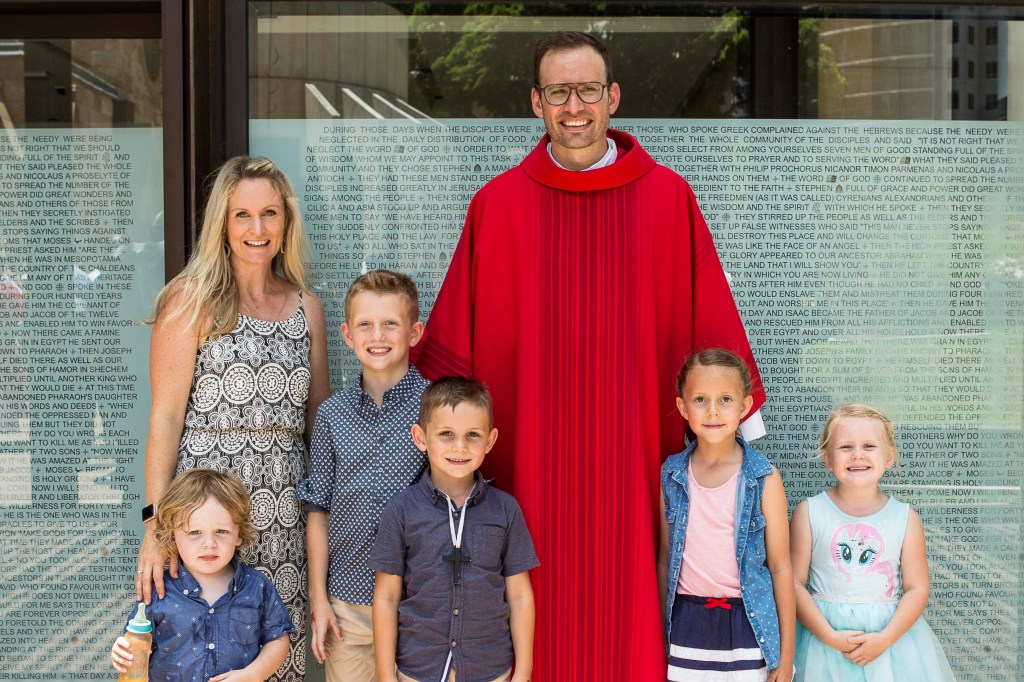
With five children between 7-13 years, Peter well knows the “circus” of modern family life. He understands how babies “change your life overnight”, the challenges of feeding, sleeping, behaviour management and just managing to get out of the house. It is “beautiful and exciting, but life-changing and full on.” He has also learned that each child has a different personality, and his relationship to each of them needs to be completely different.
So, Peter offers some helpful insights. Giving the gift of faith is like a Wi-Fi device. God is always right here, but with the ‘device’ of faith, we open our eyes to make the connection. Therefore, we have the opportunity to grow in relationship with, and have access to, God no matter what happens. Furthermore, it is difficult to bring religion into the life of children, especially when liturgy can be inaccessible. So Peter suggests a strategy he uses with his own children: a simple prayer by the cot each night after the child is asleep. This develops into prayer with the child/children, a combination of set prayers and freeform supplications. Such a ritual also helps parents to learn about what is going on in their children’s lives, and to give thanks.
One couple in particular, who remembered this homily, stands out in Peter’s memory. A year and a half after their firstborn’s baptism, the mother gave birth to a stillborn at 32 weeks. It was “tragic; unbelievably sad…they were processing incredible grief.” Yet the couple wanted to find the Deacon who had “encouraged us to pray and related to us.” So, Peter was invited to walk alongside them through this “extraordinarily difficult” time by celebrating the funeral and wake. He encouraged them to see the meaning and impact that the baby was having on their lives, even before it had been born. Together they discovered the power of human life, which can never be taken for granted, and even more gratitude for their first child.
Such stories show the value of the diaconate through Peter’s ministry. Just as his relationship is different with all his children, Peter speaks of God’s relationship as heavenly father to each child. So “when we hear different voices and experiences of God shared broadly – especially from the ambo – there is much to be gained.” His married life experience will speak to many ‘typical’ families, just as the celibate clergyman’s life will speak to others. To have both in ministry is “complementary…When they work with each other and support each others’ roles, it is a beautiful expression of the breadth of the Church.” This is the “benefit of the diaconate and also the empowering of lay ministry” both within and outside liturgical settings. Thank you, Peter, for sharing and leading the way!
 Liturgy on the Margins