
Deacon Rosie Stower, 17 October 2024
Rosie’s call to the diaconate in the Anglican Church was “totally unexpected”, yet she has pioneered a model that has resulted in many graces, for herself and others. Rosie was baptised as a child, but left the church in her early 20s to explore various other spiritualities and faiths. When she was to marry her husband, a lapsed Roman Catholic, they first approached a female Uniting Church deacon, although the wedding ended up happening at another time and place.
Still, it was the first time that Rosie had heard of, or encountered, a Christian deacon. After having a baby, she suffered post-natal depression and was lonely, having moved out of town 2 weeks after her baby was born. She started attending a small Anglican Church, welcomed and supported by two “wonderful older women”. That was where her “real spiritual journey began.”
About 15 years later, Rosie had the “weird experience” of a call to the diaconate, which was far from the more secular plans she had been making. She tested the idea on her husband, who replied, “I’ve been waiting for years for you to say something like that.” So she went to her parish priest, who directed her in approaching relevant persons in the Diocese and the eventual enquiry. At the time the Archbishop was “extremely supportive of the diaconate. He recognised it as a vital force in the life of the church”. There was an active professional Household of deacons supporting one another in the various expressions of ministry.
Rosie had already completed a course in Education for Ministry, so was well-equipped to tackle the spiritual readings and theological study that was required. In the second year, she had panel interviews, and met with other people in Formation. A wonderful “God-incidence” was that her close friend Lyn, also a parishioner of the same parish, was called and accepted at the same time, which was such a support during times of struggle. When the Diaconate was little understood, they also helped each other to advocate for it. What would set it apart from lay ministry is that it would be a lifetime, 24/7 commitment, and they would be answerable to the Bishop. They would accept the authority of the church to go to different places (the borders/fringes) to offer various ministries.
The Formation process (3 years) was a struggle in other ways as well. Overt and covert opposition to female ordained ministry persisted. There was local suspicion of the calling of ‘someone among them’. Some focussed on the ministry of priesthood, due to a shortage in that area. The study was at her own expense and it was a financial drain at a time when one of her children was still at school. But individuals were very supportive – a field committee of three chosen by Rosie met with her regularly – and Rosie’s parish have since contributed to her travel and attendance at conferences and retreats.
The whole process started in the year 2000, and Rosie and Lyn were ordained together in 2005. Some deacons minister primarily in churches, but Rosie took the solitary path of a ‘deacon in the workplace.’ There was “not a template for what that should look like”, so she had to create her own way, making it “as rich and all-encompassing as I could.”
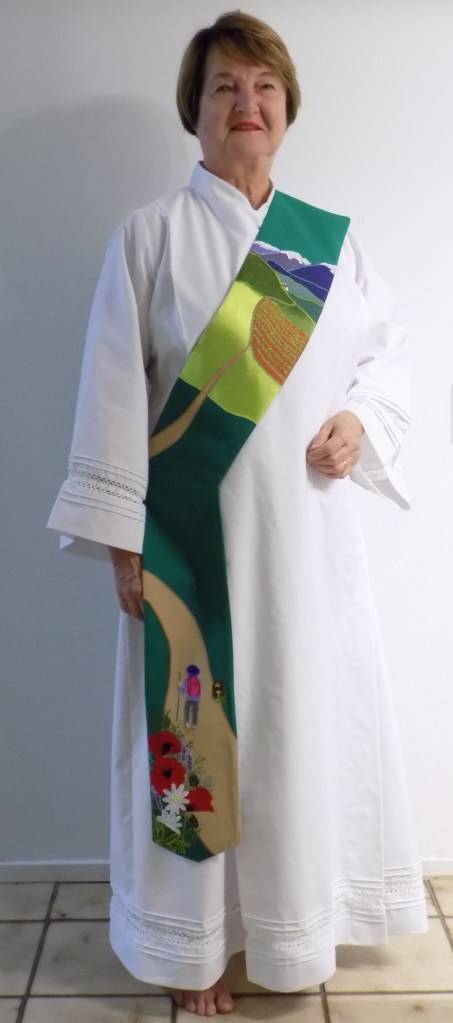
Rosie was working in Community Health, as a Child Health nurse, along with other health personnel and therapists. It was a secular environment, with many restrictions and few Christians, yet she found many ways to respond to the needs that presented themselves. Rosie was conscious of her pastoral presence, seeking to remain genuine and non-judgemental.
If colleagues have had certain issues, she has offered spontaneous prayer, which has been positively received. She has conducted blessings of couples, homes and buildings. When there was an upset about a new workroom arrangement, she created a blessing using the story of Jesus at the wedding at Cana. Rosie brought a cake and finished with a party, and the workroom still displays the printed blessing.

In these blessings, she uses “May God” as a deacon, as distinct from priestly blessings. Rosie is also not authorised to perform baptisms, but can use the ‘Thanksgiving for a Child’ from the Anglican prayer book. This has been a very positive ritual, for example when colleagues have not yet been sure that they can commit to all the creedal statements of the baptism. She cherishes one memory in particular of such a ceremony on a staff member’s property.
Rosie has also undertaken a number of other things, both formally and informally connected to her diaconal ministry. She has run workplace relaxation and meditation sessions, practised spiritual direction, conducted quiet days, advocated for staff, marched for better nursing conditions as a union member, and led services in aged care facilities. Rosie is on the roster to conduct morning prayer at her church, to preach and to administer the reserved sacrament. She has conducted a number of funerals, including her mother’s, and presided over the interment of ashes.
Rosie reflects that the diaconate has “enriched my life and that of my family.” Her husband, while on the fringes of church himself, has been with her all the way, especially assisting with anything IT or audio-visual. Recently, Rosie retired from her workplace, but continues to remain a deacon of the church. Without hesitation, she declares, “I have been extraordinarily blessed by this ministry”. She has brought that “vital force” in so many pioneering and creative ways. Thank you, Rosie!

 Liturgy on the Margins