Deacon Tony Hoban *, 13 March 2025
I present here a reflection on my experience of travelling recently to Rome for the International Diaconate Centre (IDC) Study Conference and then the Jubilee for Deacons.
I want to express my thanks my Bishop Vincent Long, Bishop of Parramatta, for supporting a great deal of my cost to attend.
I landed in Rome on Monday, Feb 17 at lunchtime and left the following Sunday night.
It was a packed 6 days of activities.
Let me start with a moving note. One of our deacons in the Diocese of Parramatta,
Rudy Rupac, died when I was on my way to Rome. I was able to have a prayer offered for the soul of Rudy at a Mass early in the week presided over by the Cardinal Prefect of the Dicastery for Clergy, Cardinal Lazzaro You Heung Sik. It was a Mass mainly spoken in Italian by a Cardinal from Korea, with prayers of the faithful spoken by an American deacon and with prayer offered for a departed Australian deacon originally from the Philippines. A wonderful reminder of the global family that our Church is.
The Study conference was a full few days held on the outskirts of Rome at Fraterna Domus in a semi-rural setting. It was attended by 140 deacons and wives from 27 countries. While there were interesting talks and workshops, the opportunity to connect with other deacons and their wives was also a highlight.

It seems that we share many common frustrations across the globe in areas such as
the unwillingness of some Bishops to support the diaconate; in some priests having no regard for deacons; in the challenges for deacons balancing their paid jobs with family, work and ministry.
But we also share common joys of the fruit that comes from our ministry whether it be in parishes, in diocesan agencies, in charitable works or in outreach to others unconnected from the church for various reasons.
I was honoured to be asked to assist as Deacon at the opening Mass celebrated by the Bishop who is called the Protector of the IDC, the Bishop of Diocese of Rottenburg-Stuttgart, Klaus Krämer. This Mass was just a few hours after I arrived, after travelling for about 30 hours to get there! I barely stayed awake!
I was also asked to give a short presentation a few nights later on a project I had worked on. I spoke on the task of establishing a new Catholic Community in Marsden Park
(a new housing estate on the north-western outskirts of Sydney).
Some of the talks at the conference were a little frustrating, I must say, because they spoke of what some of us would label an outdated view of the diaconate as a ministry of purely humble service (based on a mis-reading of the diakonia words in Chapter 6 of the Acts of the Apostles and elsewhere in the New Testament). Australian theologians and authors, John N Collins and Deacon Anthony Gooley have written extensively on the servant myth, and this has been taken up by Bishop Shawn McKnight from America. Their work unpacks diakonia more in line with the ministry of Christ and being ambassadors for their Bishops.
I was very interested in a workshop by Bart Koet, a deacon and theologian from the Netherlands. He has researched the early church, including the leadership roles undertaken by deacons. The works he has co-edited complement that of Collins, Gooley and McKnight and unpack just what the roles of deacons were in the early Church. He has also written a book on the roles and functions of the deacon in Augustine’s literary output.
A few paraphrased quotes from Koet:
- There is no mention of deacons as having a focus on being social workers in the early Church.
- St Lawrence did social work but he was also a bookkeeper and had other roles.
- There were ordained deaconesses in the early Church.
- Deacons were the go between for Bishop and the people; and between their Bishop and other Bishops; and between their Bishop and other people of authority.
- Before Augustine, presbyters were not allowed to preach (but deacons were).
I also enjoyed a talk by Marie Maincent, a French woman whose husband is a deacon. She asked a question many of us perhaps have asked: is it still appropriate to ordain candidates to the priesthood first as deacons? She said removing this could avoid the misunderstanding of the diaconate as being just a temporary step towards the presbyterate.
She noted that the theology of the priesthood has been formed over 20 long centuries
while the theology of (the restored) diaconate is still in its early days. That may explain why many bishops, priests, lay people … and deacons(!) are confused about what deacons are called to do and be!
But she also had some important things to say about the consent the wife of a man being ordained as a deacon gives. She asked if this consent is fully informed – or is she essentially writing a blank cheque? She asked whether those married deacons and their wives feel obliged to bury their challenges and pretend that life is perfect.
And Marie Maincent said something that I had never even considered before. Something I found to be quite profound. She said that a man’s wife is so much a part of his life and such a particular factor in his life that it is a key factor in his suitability to be ordained. So much so that, if he had married a different woman, he may not be suitable for ordination.
The only Latin Rite deacon to attend the recent Synod on Synodality gathering was also at the conference. Deacon Geert De Cubber, was a synod participant from Belgium. This perhaps inspired a synodal listening session to be held on one of the afternoons of the study conference. I got the job of being notetaker for my group of about 8. Our feedback was quite similar to that of many other groups. Some of the words or phrases that sum up the joy of our vocation are: diaconal collegiality, journeying together, supporting humanity, respect and diversity. Some of the words or phrases about our struggles were a lack of clarity about the theology of the diaconate, the fact that the utilisation of the restored diaconate is optional for bishops, the challenges associated with a restored diaconate which is still being quite new, a lack of balance for some in being able to undertake family, work and ministry activities. However, people were generally hopeful, despite the challenges. In terms of some potential next steps, our group came up with ideas such as respectfully (but with some authority) pushing the hierarchy to encourage the greater utilisation of deacons, to trust in the movement of the Holy Spirit and not to get bogged down in ideology, and the opportunity for deacons to play their part in the new ways our church needs to act in today’s world at diocesan and parish level and beyond the walls of the Church.
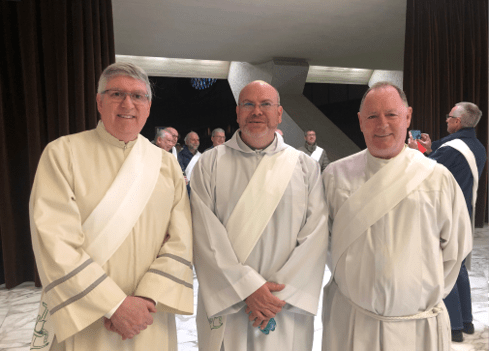
In a workshop, Deacon Callum Scott of South Africa compared what the two sessions of the recent Synod said about the diaconate in their reports. Some examples: while the first session reported that Theology of the diaconate is uncertain (§11.i), the second session reported the work of Vatican II on deacons needs to be explored (§73); the first session reported Diaconal theology needs development on its own terms (§11.h), the second reported that this should be based in actual experiences of the diaconate (§73). The first session reported that, in terms of ordaining women to the diaconate (§9.j), further theological study and reflection is needed (§9.n) while the second reported that theological discussions concerning the ordination of women to the diaconate remain open (§60). The first reported that Deacons’ ministry is service of the Word, liturgy, and mostly charity (§11.a), the second reported that Deacons are “servants of the mystery of God and the Church”, through charity, the word, and the liturgy (§73). Some subtle but important changes there! And some important new statements emerged in the second Synod: The diaconate exists to proclaim the Gospel and build up the Church (§68); and Deacons are co-responsible with the bishop (and priests) for the ministry (§§69, 74).
In terms of the world beyond the doors of the Church, we received a wake-up call from Dr Ceasar Zucconi, the Secretary General of the Community of Sant’Egidio (a worldwide movement of lay people, based on prayer, solidarity, ecumenism and dialogue that seeks to spread peace and fight poverty). He pointed out that there are currently 160 wars/conflicts in the world now – the most since World War II. He asked if there was a risk of a worldwide war and answered that his group “can find no reassuring answer.” However, he said compassion and friendship can chase away fear and hatred. “The Church can stand for ‘we’ in a world of ‘I’s,” he said. He added: “In an age of money and muscle, we can see in Jesus hope that will not let us perish. Nothing is impossible for those who choose to believe God is with us even if we seem like little people. We are strong when we pray together – it gives great strength.”
During the Study Conference, the IDC elections were held. The IDC has 1770 members who come from 73 countries. Of these, 1100 members are from Europe (most in Germany and Austria), 187 for North America and only 23 from Oceania.
The key parts or organs of the IDC are:
1. The General Assembly = a meeting of members at least every 4 years.
2. The elected Assembly of Delegates
3. The elected Executive Board
The late Deacon Nick Kerr of Adelaide (for 5 years) and then myself (in the past 4 years) have been co-opted delegates, representing Oceania in the past. I put my name forward for both the Board and Assembly of Delegates not really expecting that many people would know me or vote for me. If you are not elected for the Board you can then be included as a candidate for election in the Assembly of Delegates. I was very surprised to be elected to the Board and so now I hold the grand title of Vice President of the IDC. At the formal meeting during the conference each member elected was asked to formally accept the election to the Board or delegates assembly. I borrowed from the words of Pope Francis and said it seemed like the IDC had to go to the ends of the earth to find one of its board members! But I did accept!
On Thursday we then moved into a more central part of Rome for the Jubilee events.
On Friday we had an afternoon catechesis for English speakers with Cardinal Robert Prevost, Prefect of the Dicastery for Bishops. He is from Chicago. While he heads the Dicastery which selects Bishops, he said not to blame him if you don’t like your Bishop because Pope Francis makes the final decisions!
He reminded us that deacons are on the one hand members of the church hierarchy but also family people and workers. As such we are well placed to promote a synodal church by the way we collaborate with others in our various roles.
On Saturday we had another international event conducted by Dicastery for Clergy. Australia got a few mentions here, one by Fr Gilbert de Lima from India who has just stepped off the IDC Board. He gave a report on the Diaconate in Asia and Oceania. Marie Maincent, also from the IDC Board gave an update on her initiative to bring together local and global gatherings of women who are married to deacons and she specifically mentioned my wife, Annette, and also Ann O’Connor who supports the spouses of those in formation in our diocese of Parramatta. There were about 1,700 participants in this event. Cardinal Prefect Lazzaro, head of the Dicastery for Clergy who I mentioned earlier, was our host. He made the point that the diaconate is a gift of the Holy Spirit to the Church. But he said that while Vatican II restored the diaconate as a permanent order, the diaconate is not a new thing, but a thing of the past made new. It was announced at the end of this event that there is a worldwide survey of deacons by the Dicastery for Clergy. Its results are expected to inform another international deacons conference next year.
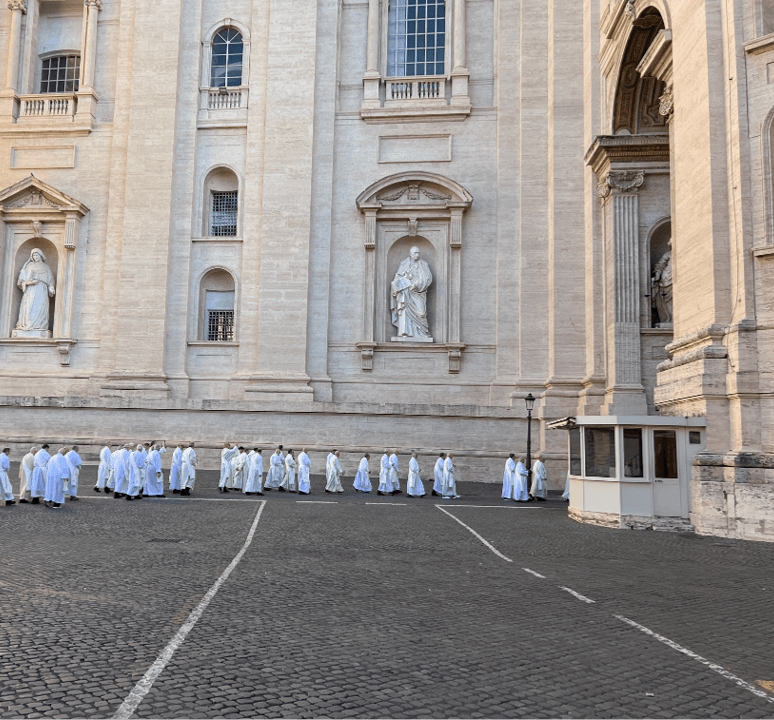
We then had many small groups process up towards St Peters to enter the Holy Door for the jubilee. I offered prayers for many intentions close to me as I entered the Holy Door, including for the diaconate community in Australia.

The culmination of the Jubilee was the Mass on Sunday, February 23, in St Peters Basilica
(sadly without Pope Francis being able to be present). However, there were 4000 deacons present. There are 50,000 deacons in the world, so, one in eight was there – something quite amazing! To my knowledge, I was the only Australian deacon there. 23 deacons (two from Brazil, six from Colombia, one from France, three from Italy, three from Mexico, two from Poland, three from Spain, and three from the United States) were ordained at the Mass. It was my first Mass at St Peters and so it was an experience to treasure.

While Pope Francis couldn’t be there, he wrote a homily that was read by Archbishop Rino Fisichella the Pro-Prefect of the Dicastery for Evangelization in which he encouraged deacons to be apostles of forgiveness, selfless servants and builders of communion. Pope Francis encouraged deacons to serve joyfully and with humility without seeking recognition, thus heeding the example of Jesus who teaches us that greatness comes through serving others (Mark 10:45). “Through your cooperation and generosity, said the Pope, “you will be a bridge linking the altar to the street and the Eucharist to people’s daily lives.” He wrote: Deacons express communion by making others feel valued and included, not just with words but through their actions. “Your mission sets you apart from society only to be re-immersed in it in order to enable it to be an ever more open and welcoming place for everyone,” the Pope said.
At the Angelus that day, his words were read. He praised the dedication of deacons to carrying out their ministry in the Church with words and deeds, bringing God’s love and mercy to all. He urged us all to continue with joy and love, saying: “Do not be afraid to risk love!”
And then it was time to start the 30 hour journey home. I arrived with just enough time to shower and attend the funeral of Deacon Rudy, who I mentioned at the beginning of this reflection. After a meal with family members that night my wife Annette and I set of for Adelaide for our Australian National Deacons Conference.
It was therefore a whirlwind few weeks of going deep into the diaconate world, but a time of many memorable experiences, with much to ponder and review for a while to come.
*Tony is a deacon of the Diocese of Paramatta, Chair of the National Association of Deacons and is just completing his term as Vicar for Deacons in the Diocese of Parramatta.
 Liturgy on the Margins