Deacon Francisco José García-Roca López, 1 May 2025
Today I am privileged to share the story of a deacon from Spain, who kindly offered to write about his experience of call and ministry. He original words were in Spanish, and Google Translate has helped to make this translation to English possible. ¡Muchas gracias, Francis!
Ministry journey
My name is Francisco José García-Roca López, and I was born in the city of Melilla, a Spanish territory on the African continent. I am the father of four daughters and two grandchildren. I am a retired military officer and a psychologist. I currently work as a counselor in public education, combining this with working as an expert witness in ecclesiastical courts, where I have conducted more than 500 psychological evaluations.

Vocational testimony: I have often been asked, and I’m sure almost all deacons, about how their vocation arose, what on the other side of the pond is called “the call.” Perhaps they expect to hear an extraordinary story, like an inspiration in a moment of prayer or a revelatory dream. What they surely don’t expect is for my vocational story to consist of the fact that I began discernment because after my military studies, I began studying psychology, and when I graduated, I found myself thinking, “Now what do I do?” And that’s when I realized it was time to study to be a deacon. What a shame if this cold call I just described were really true; therefore, it’s worth delving deeper into it to discover the true essence of the vocation.
The truth is, when people ask me, I usually say that you should ask my wife about my vocation, because she claims that the thought of the diaconate had been on my mind ever since she met me.
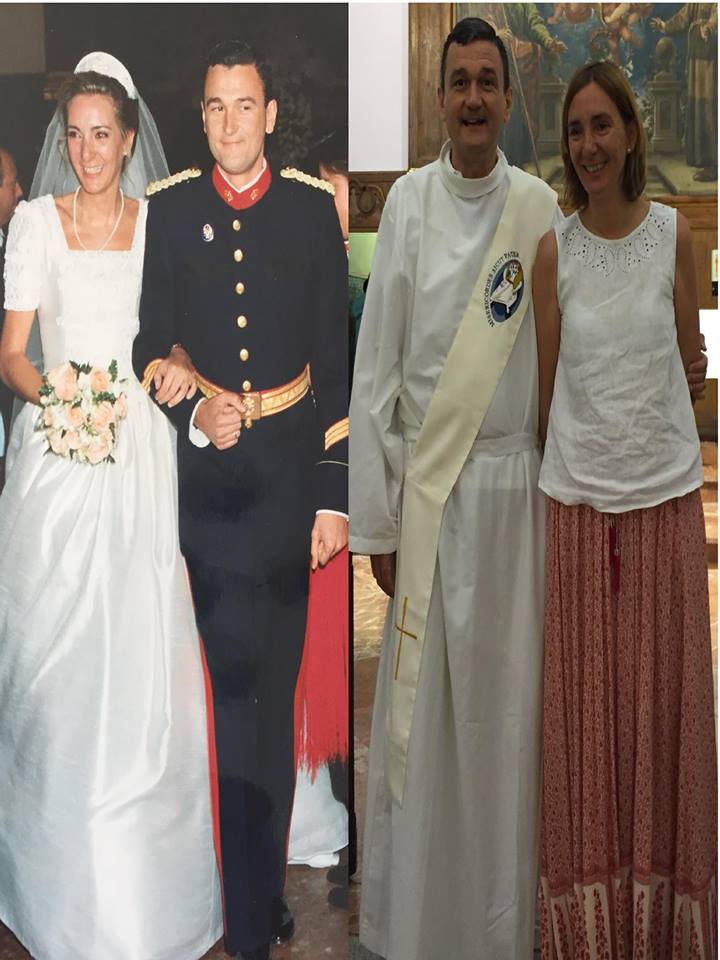
I’ll start by pointing out that I was very clear that the priesthood wasn’t for me. Quite a few priests who saw me very involved with the Church asked me if I wanted to enter the seminary, and the truth is, that didn’t even cross my mind; I was very clear that marriage was for me. Years went by, and once I was happily married, I asked myself, “Hey, why was I so sure I didn’t want to be a priest?” Today, seeing my wife, my daughters, and now my grandchildren, I find the answer clear: my calling was service, the diaconate.
So how did my vocation begin? It turns out that upon leaving the military academy, I requested a posting to the North African city of my birth, Melilla. Shortly after arriving, I participated in a Sunday Mass and was notified that they needed catechists. So, as soon as Mass was over, I volunteered and was welcomed with open arms, assigning me to a group on Saturday mornings. Already beginning my Saturday work, I noticed what was posted in the confessional of this parish of the Sacred Heart of Jesus, where my grandparents were married, a priest to hear confessions. It was a perfect fit, and I began confessing to him. I casually asked who it was, and they told me it was Don Ramón Buxarrais, the Bishop Emeritus of Málaga, with whom I had been confessing for several Saturdays. I remember being struck by his wisdom, advice, and even his peculiar penances, including one very striking one I remember: buying a coupon for a charity—it could be La Gota de Leche, where he worked, or ONCE—and tearing it up without looking at it, as if it were a form of alms. I was also told that, as Ordinary of Málaga, he had clashed with the then-famous Marbella jet set, begging them not to set a bad example of wastefulness, and that he had received much criticism for this, which had caused him great suffering, to the point that they accepted his resignation. He then set a praiseworthy example by retiring to a care center to help the poor in Melilla and dedicating himself to charity. What a wonderful bishop emeritus! I’ve heard news that he’s very old and lives in a center for elderly priests in Málaga.
Well, it was with Don Ramón that I first heard talk of the permanent diaconate. He asked me if I wanted to be a priest, and I said no, that marriage was my thing, and that’s when he asked me, “Have you considered becoming a deacon?” Something I didn’t know, and I must have looked dumbfounded.
Later, I learned that Father Ramón had been the bishop delegate responsible for the Permanent Diaconate of the Spanish Episcopal Conference. Years later, and already in Madrid, stationed in the Royal Guard and married with two daughters and collaborating intensely with Mother Teresa of Calcutta’s Missionaries of Charity, after talking it over and praying about it with my wife, I shared my concerns with my spiritual director, and he referred me to the then delegate for vocational ministry, who put me in touch with the vicar for the clergy. That’s how my wife and I ended up the following Saturday entering a classroom at the Conciliar Seminary, where we, the then few aspirants who were on the path to this ministry, were greeted with a fraternal welcome.

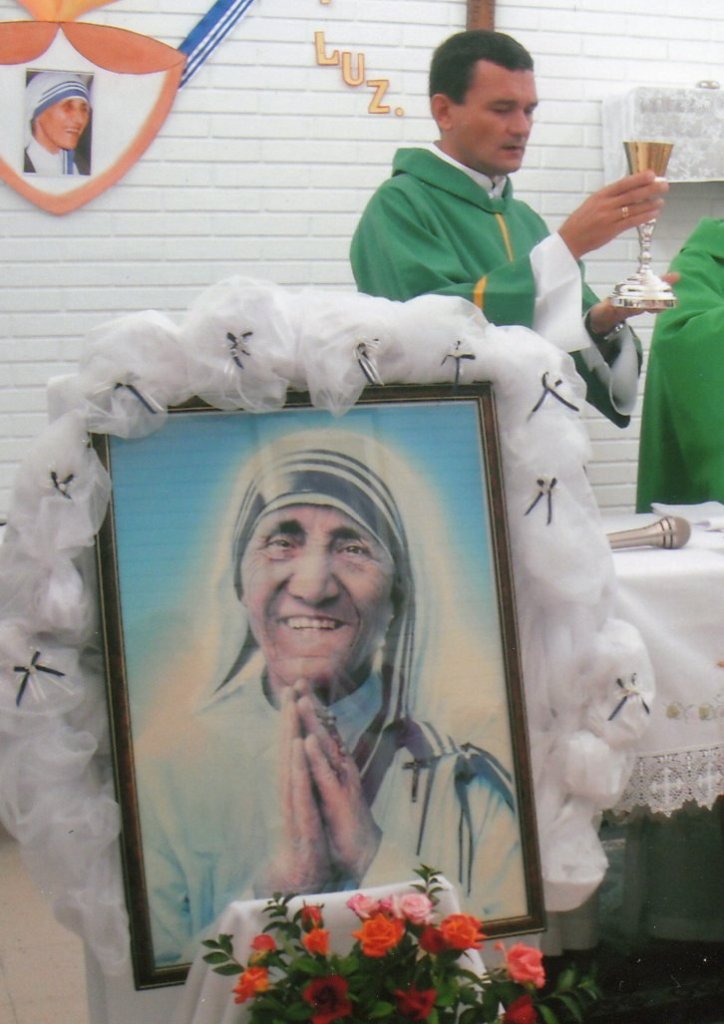
I emphasize that those moments when I took the step of starting, I balanced my role as husband and father with my work and volunteering with the Missionaries of Charity. Without a doubt, the message they convey from their founder, Saint Teresa of Calcutta, of wanting to quench Christ’s thirst in the poorest of the poor, and that impeccable consistency of a life of service, of becoming poor themselves to be true sisters of the poor, were undoubtedly instrumental in my desire to be configured to Christ the servant, to the one who did not come to be served, but to serve.
Liturgy on the margins
I came to know a marginalized community thanks to my collaboration with the Missionaries of Charity, the congregation founded by Saint Mother Teresa of Calcutta. It was because the Lord placed my parents’ home between the home the missionaries owned and the soup kitchen where they cared for and fed more than a hundred people daily. What can I say about how much I owe the Missionaries of Charity! They taught me to see a brother or sister in those who have nothing and they helped to increase my love for the Church. With them, I served those who wanted to eat in the soup kitchen. I spent nights with them during the time when AIDS was ravaging young people and people were dying weekly. I have accompanied those suffering from withdrawal symptoms to wait in line for methadone. As a family, we have traveled from the time my daughters were little to the present day on vacation to volunteer with them. Well, thank God, I continue to collaborate with them in precious tasks such as assisting the homeless on the streets, caring for HIV patients at the Home at night, and other less visible, but important, tasks for them, especially delivering food as a driver.
The value of the ordained diaconal ministry
These times we live in make it conducive to the dissemination and promotion of this ministry. Deacons live in direct contact with the realities of the world. By being integrated into their community, they have the opportunity to exercise a closer and more accessible pastoral ministry. Their daily lives allow them to bring the Christian message to places where many others cannot. Work, interactions in the neighborhood, meetings at their children’s school, or even daily shopping are moments in which deacons can serve as witnesses to Jesus Christ. It would be opportune to encourage young vocations so that they can exercise a long, safe, and fruitful ministry.

To read more about Deacon Francisco and his blog on diaconal topics, see
https://diaconofrancis.wordpress.com/?_gl=1*eyj1bl*_gcl_au*NzQzMzA2MDMxLjE3NDA1MDA1MjE
 Liturgy on the Margins