
Elizabeth Young rsm, 23 October 2025
I belong to an international religious order – the Sisters of Mercy of Australia and Papua New Guinea. And we have been celebrating our newest saint: St Peter To Rot, who was canonised on the 19th of October, the first one of his country.
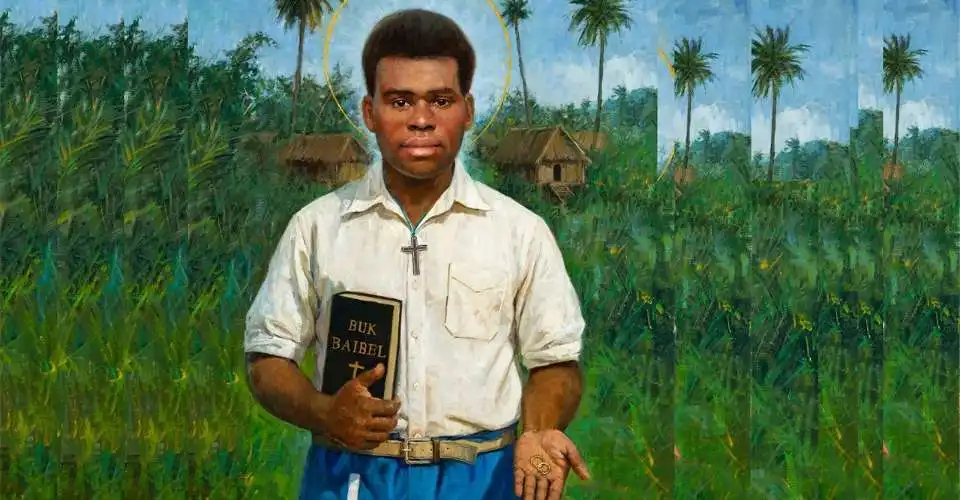
Reading the news this week, it suddenly struck me that I also have a new patron – Peter is the patron of Catechists. He is part of a long history of Catechists who have served as local church leaders in countries such as Papua New Guinea, the Solomon Islands, Angola and South Sudan. They have evangelised, ministered, led liturgy and kept the church alive, especially in places less accessible to ordained clergy. Catechists have been both men and women. I thought this was a more recent development (for example, in South Sudan), but in the Solomons there are documented married catechist couples from at least 1924. Some are full-time and others part-time and, ideally, they all undergo serious training and formation.
I have been privileged to visit Papua New Guinea six times with the Sisters, and have seen catechists in liturgical action, leading prayers (Lotu) when there is no priest. They have an important place in the community and the church. In 2021, Pope Francis issued an Apostolic Letter, Antiquum Ministerium, establishing the lay ministry of catechist in the Catholic Church. It recognised those already in this role as having a true vocation, for “those lay men and women who feel called by virtue of their baptism to cooperate in the work of catechesis.”
Saint Peter was a Catechist, and heroically served to keep his Catholic community alive under occupation. He was married, and is an inspiration for other married people. He has now become a patron for all catechists. In Australia, the name ‘catechist’ has mostly been applied to those teaching Catholic religious education classes in schools or leading children’s programs in parishes. However, a number of women and men have been instituted into the broader ecclesial role envisioned by Antiquum Ministerium.
While the vocation of Catechist is not usually meant for women in religious orders, my Bishop suggested that I be instituted as a catechist on coming here to Wilcannia. It is a whole-of-life, ecclesial and vocational ministry that supports my particular job (Parish Life Coordinator). My own function as a catechist here is not so much about teaching – there are fine Catholic educators in the town – but being the face of the Church. In a way, I have found it similar to the role of a chaplain in a prison or hospital, except this time it is in a town and its environs.
Under the Bishop as parish priest, and the auspices of the Sisters of Mercy, it is an honour to be joyfully present. A catechist here is being a day-to-day, 24/7 representative of the Catholic faith community and facilitating its pastoral and liturgical life. This does not mean doing everything myself, but trying to encourage each person’s gifts, from the visiting clergy to the worshipping community to the wider local community. And there is a special role for preaching in the liturgies, baptisms and funerals – to listen deeply, reflect, pray and speak of the love of God and our unity in Christ.
St Peter To Rot, pray for us and for all Catechists.
 Liturgy on the Margins