
Sr Silvia Campo RSM, 6 November 2025
This week, Sr Silvia Campo shares her own story about a liturgy with the community of Italian background in Melbourne. She has supported them in many ways over the years. Thanks, Silvia!
With great enthusiasm and some degree of insistence, Rachel – we are old school friends from the early 1970’s – invited me to attend the Mass for the FESTA DELLA MADONNA DEL TERZITO. This was weeks before the actual day. All details would be in the Italian Paper later, she explained. Rachel hurried to add that there would be afternoon tea in the crypt of the church after Mass. The remaining time spent talking about the forthcoming celebration revolved around this, a key feature of any celebration, liturgical or otherwise.

“But who is catering? Do people bring a plate?” I asked. No, Rachel would co-ordinate friends and family members, including grandchildren, to provide everything. It would be wonderful. She had done it before, and I must stay for the afternoon tea.
Being Sicilian myself, and having participated in numerous Italian religious feasts (Festa) in country Victoria with a large Italian population, I knew what to expect. An Italian priest told me once that the best way to get people to Mass on a regular basis, was to have a ‘Festa’ at least once a month. This could be by marking special occasions: e.g. Christmas, Easter, harvest, Mothers’ and Fathers’ day, end of the Italian Mission, Italian cultural days, or particular saints – patron of their hometown back in Italy, etc.
I’m aware that Italians don’t have a strong tradition of being Sunday Mass goers. The women may be more inclined to attend, even on weekdays in many cases, with groups gathering to say the rosary in church before or after their parish Mass, or in someone’s home. The men will more readily attend if they need to accompany the women to a particular church, or if they have a part to play such as musicians, candle or statue bearers or other organisational roles, and then the social side, with good food and meeting friends after Mass, is also a strong attraction.
I knew the venue, St Mary Star of the Sea West Melbourne, the largest parish church in Australia, and the parish where I grew up and received my sacraments, so I showed some interest and promised to attend. I listened to the story.
Rachel and her husband’s family have been involved in organising this celebration in honour of Our Lady, the patronal saint of their native city of Salina in the Aeolian Islands, Sicily, for over 60 years. As migrants here, the ideal is to reproduce the celebrations they have participated in many times, held on the 23rd of July (summertime in Sicily), when family have gone to their ancestral home there for holidays.
Some adjustments for Australia have been needed.
Here, the feast has been moved to October, a time when we can expect more clement weather. Very important this, as the liturgy always used to include an outdoor procession with the statue, candles and flowers, possibly a band playing, and the singing of hymns specific to the feast or saint. It belonged to the whole town, not just a church event.
These days the Mass remains central, but other features have had to be modified to accommodate an ageing population, costs, availability of a priest to celebrate Mass in their language, not everyone being bi-lingual, thus requiring the service to be in both English and Italian, and the need to attract younger generations so they are willing to take part without embarrassment. The fact that a Filipino Bishop, able to speak some Italian, would be celebrating the Mass this year made it really special.

Many years ago, Rachel’s family had organised for a larger-than-life-size statue to be made and brought to Australia, to reside permanently in St Mary’s. It replaced the painted image of Our Lady formerly used. No doubt it must have been at great expense, suggesting that over time, not only one family, but people from the town or region united in contributing to the cost of having their own statue here, not just remembering what was done back home. The $50 and $20 notes I saw on the collection plate at Mass were evidence of this on-going financial support for the ‘Festa’. It’s usual for images of the saint to be available for veneration on the day, or to take home.

The patron saint’s story generally goes back to some special event or miracle in the distant past, for which the people still wish to express their gratitude to God, and they take pride in what that saint did for a particular person or town in their region. They all know the story, and want to pass it on to the next generation.
An organising group take ‘ownership’ of the event, and plan for months to ensure a successful day. As people from different parts of Italy intermingle in Australia, they readily attend a Festa from another region than their own, which of course means they may go to many celebrations throughout the year. These are usually advertised in the Italian newspaper.
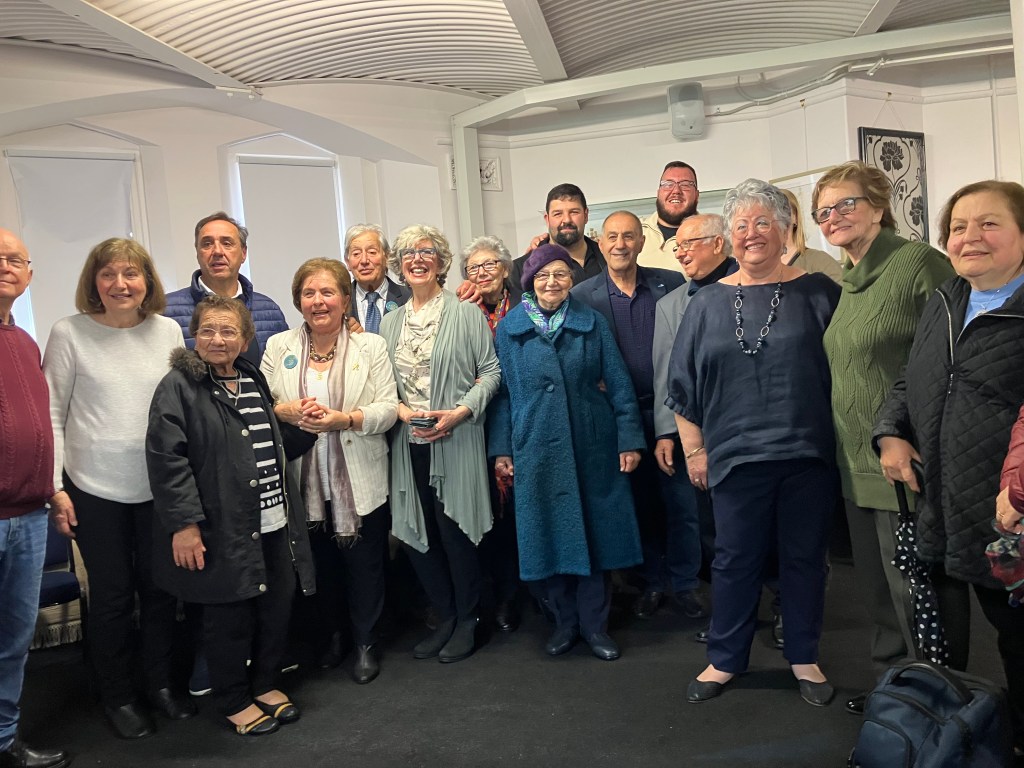
My attending this Festa was more than just going to Mass.
It brought back so many memories of similar celebrations I had attended all my life. The familiarity of the rituals, brought a sense of belonging. Meeting up with people not seen for a long time brought joy and a strong sense of connection, family, identity.
Of course, the majority tend to be older people these days, but it’s so heart-warming to see the younger ones there wanting to support their family member, who otherwise wouldn’t be able to attend.
Here, even the feeble 92-year-old in aged care, with some dementia, could join in the familiar hymns and rituals of the Mass and be his old self. His pride and joy in being surrounded by his children and grandchildren, and being warmly greeted by many who have known him for years was evidence of him feeling very ‘at home’ with it all. His daughter told me this annual celebration is as important as Christmas for him.
As expected, the table was laden with goodies for afternoon tea. The Italian biscuits and cake were the first to go, people remarking how this or that reminded them of the ones their mother used to make. The younger generation showing interest in learning how to bake them, while also enjoying the familiar sandwiches which evidenced the intermingling of our two cultures.
The communal aspect of the Festa was obviously central to the day’s service to venerate their beloved Patroness: the Madonna del Terzito, and to uphold the ancient tradition and culture in a foreign land that is now inextricably part of their family.
Regardless of whether they are regular Mass goers or not, participation in such liturgies on special days, shows the deep spiritual, social and cultural connection liturgies can give.
The people attend out of their desire to participate, (not because they have to go), to be true to their heritage, and to pass it on to the younger members of their family.
Apart from such occasions as I’ve described above, in my day-to-day connection with older Italians, I’ve learnt that even those living with dementia can respond to hymns, rituals, and religious images or places that touch into their lives in the distant past. These deep-seated memories associated with very special occasions celebrated in a church or other religious context, can assert themselves and for a moment, the person is alive again, back in that time or place. The emotional connection makes up for any memory loss.
A good reason for involving the aged in our liturgies, as we will never know when or how it may touch them. We will always be pleasantly surprised by the Spirit’s gifts.
So, I ask myself: how would things be different if we had ordained deacons?
Instead of starting with getting the okay from the priest, the deacon would be the ‘go to’, approachable person to facilitate the organising group to connect with all involved, because she would know the people and their gifts. She would ensure the liturgy they prepared would be appropriate to the situation, languages and gender inclusive.
For the older generations she would find a suitable priest to add solemnity to the occasion and respect their wishes. In time, the children of migrants would more readily accept a lay person to lead a service in the church. She would delegate and involve as many as possible in the different aspects of the celebration.
Essentially, I imagine the deacon is someone who walks in solidarity with the people in her care. She gets to know them, encouraging, supporting, and when necessary, educating them about the current teachings of the church. There wouldn’t be any form of ‘US’ and ‘THEM’ dividing the community. This would enable them to transition from, but still value and respect, the handed-down, ‘cultural-devotional’ style of religion they may have grown away from. Thus, they – Italian migrants, or people in any group on the margins – may more readily embrace a new way of being Catholic that helps them connect spiritually with each other, their God and the younger generations.
 Liturgy on the Margins