
Beth Doherty, 9 December 2025
Beth had been preparing to share her story, in her words, for this blog, but was recently impacted by the Commission on the Diaconate of Women’s published report. Her experience is certainly not unique. Thank you, Beth, for sharing the following reflections.

When the news landed on my social media feed on Friday morning that the Vatican’s commission for the study of women in the diaconate had once again said “no”, my reaction was visceral. A sharp drop in the stomach.
I attempted the familiar process of rationalisation: It’s not definitive. Further study has been recommended. I spoke to some friends and colleagues. My public education colleagues saw it as further proof of how “out of touch” the Catholic Church is, an irrelevant monolith. Let’s be honest, many of my Catholic friends did too.
Eventually, I recognised the sensation for what it was: indigestion. Not metaphorical discomfort but the realisation that the decision itself was indigestible—because something in it was poisonous. Not poisonous in intent, perhaps, but in the cognitive dissonance it reveals.
Just two months ago, Pope Leo released Dilexi Te, his first encyclical as pope. In paragraph 12, he quotes Fratelli Tutti:
“The organisation of societies worldwide is still far from reflecting clearly that women possess the same dignity and identical rights as men. We say one thing with our words, but our decisions and reality tell another story.”
Let me just bold, italicise and underline that for you. These are the Pope’s actual words.
We say one thing with our words, but our decisions and reality tell another story.
What, then, do these words have to say to a commission that declined to affirm women’s access to the diaconate, the most service-oriented of the ordained ministries? Their report acknowledged the hope that instituted lay ministries might be expanded for women, offering “adequate ecclesial recognition” of the diakonia already being carried by them daily. But hopes are not decisions. Hopes change nothing.
In a media release from the Canberra reform group Concerned Catholics, a scorching and articulate critique argues thus:
“Arguments in the report are presented in archaic language that smacks of sophistry, intended to confuse and sow doubt. Indeed, it borders on being seen as nonsense. An example is the report’s depiction that appointing women deacons would be ‘a rupture of the nuptial meaning of salvation’.”
It is unclear how allowing women to do what they have been credibly shown as doing in the Bible — (The Bible refers to female deacons (or women in similar service roles) primarily in Romans 16:1-2, where Phoebe is called a diakonos (deacon/servant) —will rupture the nuptial meaning of salvation (whatever that means), but I guess we won’t find out.
The truth is that women’s “diakonia” already sustains the Church. And the refusal to grant recognition to this reality is not just a missed opportunity; it is a contradiction.
I know this contradiction intimately. Every Sunday I sit behind a keyboard and microphone in my suburban Canberra parish—the largest in the Archdiocese.
I have been studying theology for over 20 years at this point. Last week, at dinner with my Parish Priest he joked to me: “You are way more qualified that I am, you should be up there giving the Homily instead of me” (I don’t think it’s his favourite thing to do). Yet in the context of the Eucharistic liturgy, I cannot preach. I can sing, but only as support.
Before Vatican II, women weren’t even permitted to sing in the liturgy. Today, our voices are welcomed—but our silence at the ambo speaks louder than any hymn we offer.
But, if I’m honest – this isn’t even the real kicker about this decision. It’s not about power or leadership even. The diaconal ministry is about service, humble service.
I don’t think most women who seek the diaconate are secretly harbouring fetishes of processing into St Peter’s Basilica in a mitre or dreaming about donning a roman collar. Actually, they already perform the majority of diaconal functions, mostly without recognition. I think they just want “the same pay for the same work”, to coin a secular phrase — Ironically, not a whole lot of pay — “the pay isn’t great, but the superannuation is out of this world” — says the old maxim about priesthood.
What unsettles me most, though, is the way women often become the guardians of their own exclusion. When I posted a link to an article about the “no” decision, a woman was one of the first to tell everyone who was disappointed to get back in their box, that women already hold roles as Diocesan Chancellors and agency heads. Another kind woman once said firmly to me, “I just don’t agree with you changing the pronouns! God is my Father.” The default masculine grammar flows unquestioned, even though older women in our parish quietly alter the psalms as they proclaim them. Some read inclusive language with a giggle. Some with a frown. These small acts signal a yearning for a more spacious imagination.
My own yearning to participate began early. In 1994, I asked our parish priest if I could become an altar server. He knew my family and I well as he frequently came over for dinner and debated theology with my mother until the early hours of the morning. He said “no”, uncomfortably, I think a bit surprised at my boldness. Some parishes in my diocese had girls performing this role, some didn’t—it depended entirely on the priest’s theology.
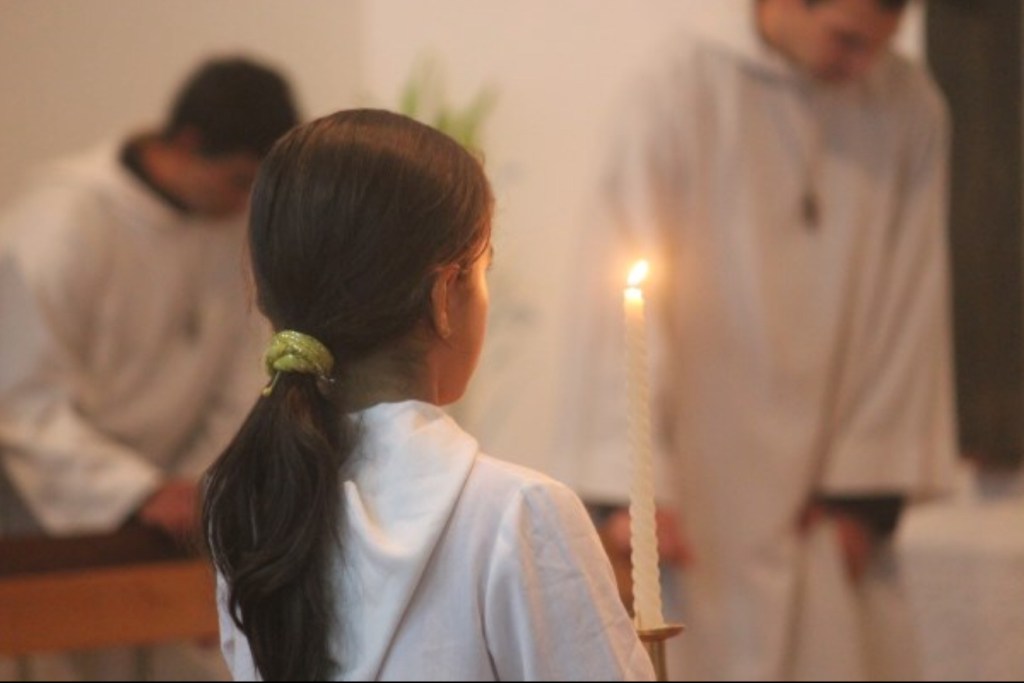
By the age of sixteen, I was composing songs, and I wrote a song with the lyrics, “God is there and he’ll/she’ll always be.” After Mass, self-appointed guardians of orthodoxy cornered me. My priest had approved it—but that didn’t matter. My lyrics were “unscriptural.” My father, then on Parish Council, defended me so fiercely that he walked out and has never returned to formal parish life.
Over the years, I’ve accumulated several small objects that represent the formation—and deformation—of my Catholic womanhood: a lace mantilla, a True Love Waits ring, the book “Boy meets girl” by Joshua Harris. These are the relics of purity culture: a theology that masquerades as virtue but functions as control.
Purity culture—popular in evangelical circles but deeply internalised within Catholicism—teaches girls that their holiness hinges on sexual purity. I grew up hearing analogies that reduced girls to wilted flowers, or, in one particularly problematic youth group session, sticky tape with no more “stick”. Boys were told to be strong. Girls were told to be responsible—for themselves, and for the behaviour of the boys around them.
By nineteen, after some perfectly normal teenage relationships with nice Catholic boys, religious scrupulosity consumed me. Shame became my default position. I confessed the same sins over and over. I volunteered obsessively. I tried to earn back a purity I believed I had lost. This is what happens when the Church teaches girls that their worth can be broken by touch. I started to think I was not worthy of leadership, even of love, and yet did not apply the same standards to the boys and men around me making the same or worse “mistakes”.
Two saints illuminate the consequences of this culture: Maria Goretti and Dorothy Day.
Maria Goretti, canonised for resisting sexual assault, is held up as the epitome of virgin purity. Yet the real heart of her story is her forgiveness. Meanwhile Dorothy Day—who loved, failed, repented, started again, had an abortion, then later a child outside marriage, and built a movement of radical hospitality—embodies mercy, justice, and a holiness capacious enough for failure.
Yet which woman is offered to Catholic girls as the model? Which story is sanitised for safety?
And what does this have to do with women’s roles in the Church? The elevation of purity over integrity shapes not only sexuality but power. Men’s failures are treated as lapses. Women’s are catastrophes. Church documents uphold women’s dignity while confining them to motherhood. Humanae Vitae places the burden of fertility management squarely on women. Ordinatio Sacerdotalis forecloses the conversation about women’s ordination with a single sentence.
And now the diaconate commission tells us that further “study” is needed—while Rome continues to ask women to remain patient, remain hopeful, remain silent.
Yet, we remain. At least some of us, many holding on by our fingernails.
We remain not because the Church has earned our loyalty, but because the Gospel has. We remain because our longing for justice is not a departure from the Catholic tradition but a deep fidelity to it.
Dorothy Day once said, “Don’t call me a saint—I don’t want to be dismissed that easily.” She understood that holiness is gritty and embodied, lived in the kitchen and the picket line, not depicted in stained glass.
So where do we go from here—after another “no,” another door politely but firmly closed?
I for one am a bit sick of climbing through windows, of trying to smash the stained-glass ceiling. I’d like to get on with the real work of reform, get my hands dirty ministering in the real muck and mess of people’s lives. I’m tired of arguing. I don’t want to expend more oxygen on arguing for truth when this energy could be spent on service, singing, and even celebration.
The Church needs women not as symbols of self-sacrifice or paragons of chastity but as leaders, teachers, theologians, prophets, and preachers.
The “no” is a failure of imagination. It is a non-definitive decision, because the words are there in scripture.
The Church does not merely include women.
The Church is women.
My hope is simple:
May women preach—not merely through music, but with words.

May our hymns rise as both prayer and protest.

May the Church expand its theology until it can hold the fullness of women’s lives.

May we listen to the stories we once silenced.

May we refuse to shrink.

May we refuse to leave.
Our time to speak, sing, and lead is now.
Beth Doherty is a Canberra-based storyteller, teacher and musician who seeks to use creativity and professional skills for the greater good. She is deeply passionate about justice and international development and particularly how this is lived out in faith spaces. Her most recent book is called “An Attitude of Beatitude” and can be accessed at Willow Publishing.
 Liturgy on the Margins
Well written, Beth! I am right behind you and my daughter, Sister Elizabeth! It is yet another stab in the back! However, keep on nudging away and eventually the ‘old-school thoughts’ will fall off the cliff and common sense, appreciation, gratefulness… will stand firm.
LikeLike
Everything you say resonates with me, Beth. I am more determined than ever to resist the patriarchal clericalism, and be a voice and a witness to the real gospel of Jesus. I refuse to give up.
LikeLike
Thanks Elizabeth and Beth. You are both courageous in being faithful to the scriptures and the teaching and practice of Jesus and Paul. I shed a few tears reading your story Beth. I had already read the excellent Canberra response but this was deeply personal. Thank you for sharing such a meaningful yet painful story.
It deeply pains me to know that women are denied their God – given rights to serve in the Catholic Church by “old men dressed in fancy robes and pointy hats”, Yet as one of two Cristian Brothers present at the Rising Tide Protest on Sunday Nov 30th Nov, I and several Mercy Sisters, joined with others of many faiths (or none) in a moving Sacred Service at Horseshoe Beach led by a dynamic priest of another faith Rev Alex SANGSTER. [image: image.png] I trust that I will not be condemned to hell for spending 8+ hours on trains and buses to be inspired and pray but committing a “mortal sin” missing my “Sunday obligation”.
Please do not give up, keep smiling, make others joyful; ð¥°ð¥° Richard Rohr reminded me this morning that John of the Cross did just that, while in “the dark night of the soul”, perhaps something like what you must be enduring right now.
Tony
LikeLike