Grace Healey, 22 January 2026
Welcome to 2026! This is the first blog of the year for Liturgy on the Margins, and we hear from Grace Healey in her own words. Thanks, Grace!
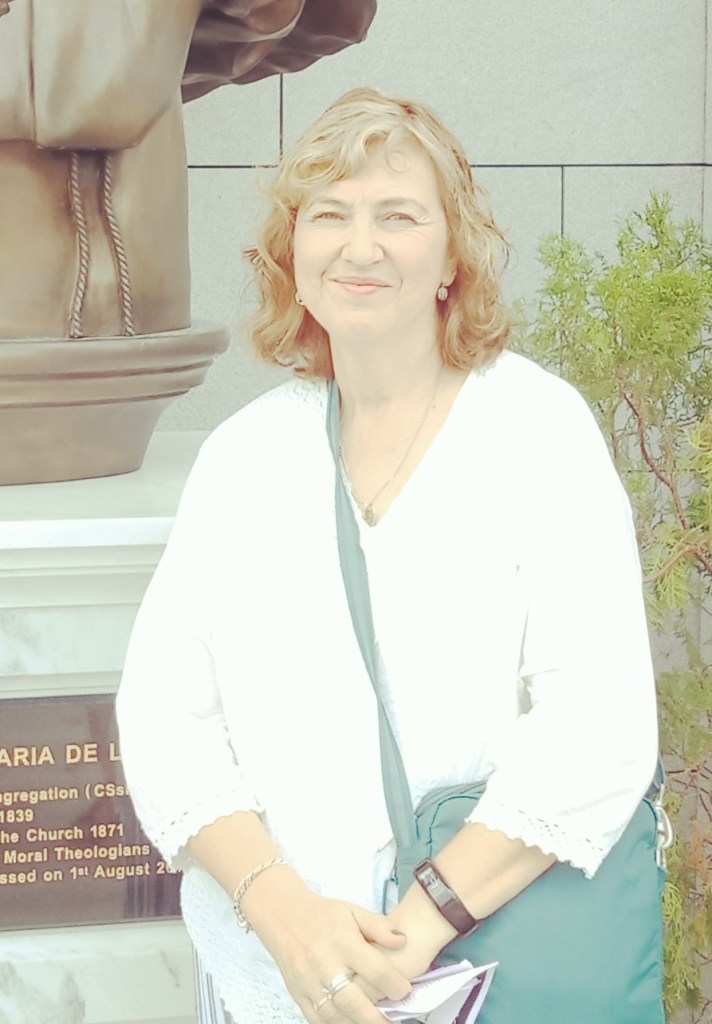
Elizabeth: Tell me a bit about your own ministry journey.
I was born in Adelaide to a Maltese family and my Catholic upbringing started from there. At primary school I was taught by the sisters of Our Lady of the Sacred Heart. When I was fifteen, I thought about wanting to be a nun so I could teach children about Jesus, but that thought did not last long.
I decided to take the pathway of marriage and children, and now have been married to Peter for 45 years. My lay ministry did not start until my first child, Michael, was a year old; it was teaching Sunday School at St Augustine’s. So God made possible my wish to teach children about Jesus. When they decided to change Sunday School to Children’s Liturgy, I was one of the Children’s Liturgy’s first Leaders. Then I started to help with the sacramental program, building lots of experience in the formation of children. Even after I gave birth to my second child, Christine, I started volunteering on the counting team because I worked in banking and wanted to give back with my God-given skills. My husband did a lot of babysitting for me and supported my Ministry.
At my mother’s death bed, a Catholic woman Chaplain came and said a few prayers and offered us all Holy Communion. Something happened to me at that moment, and I asked God if it was his will that I become a Hospital Chaplain. Things started to happen after ten years.
In 2007, I went from full-time in the Credit Union to three days a week. I began volunteering at the Lyell McEwin Hospital one day a week and did a Clinical Pastoral Education course with the Ecumenical organisation. Then I was asked if I wanted to join the Catholic Ministry Formation Program part-time over four years and I said yes. That became my serious journey to take on a position in the church. I did not know where it was going to lead, but the MF Program helped me to discern what my Ministry was going to be. The Program’s retreats confirmed for me that I was called to go into Lay Ministry.
My first role in 2010 was Pastoral Associate at Modbury/Para Hills parish. When my hours were reduced, I took on a role as Chaplain at the Lyell McEwin Hospital one day a week. This led me later to take on a 4-day part-time position as a Chaplain in the Royal Adelaide Hospital. I was six years as a Pastoral Associate and another 8 years as a Chaplain. When I finished my studies in the MF Program, I received a Diploma in Lay Ministry. Then I went on to study Spiritual Direction, and after four years I received my Certificate, and now have a three-year accreditation with the Archdiocese of Adelaide as a Director.
I reduced my hours again as Chaplain and worked at the MF Program as Spiritual Coordinator, but was only there one year before the program was discontinued by the Archdiocese. God provided me with another role as Pastoral Associate at Salisbury Parish, and I have been here for three years in October.
Elizabeth: Tell me about an experience of celebrating liturgy that was very meaningful with a community ‘on the margins’.
When I worked at Hampstead Rehabilitation, the churches took it in turns to have a liturgy. I was rostered for one year to offer the patients a liturgy on Easter morning.
I prepared a Powerpoint, music and had a reflection, asking my son to operate the Powerpoint for me. About fifteen people turned up, from all different denominations. I gave some people readings and, at the beginning, told them that it would be a Catholic liturgy with Holy Communion. They all stayed. After the liturgy, patients said that it was lovely and thanked me. As always, whether it was a bedside liturgy or a larger gathering, it was a privilege to be able to officiate the liturgy. I had a good relationship with Hampstead Rehabilitation Hospital patients.
Elizabeth: What do you think is made possible by the ordained diaconal ministry?
The diaconal ministry can help priests and parishes to perform sacraments and rituals, such as Baptisms, Funeral liturgies, Wedding liturgies and their preparations. They can teach the sacraments, offer pastoral care, Spiritual Direction, perform Youth and Altar Server training and be Chaplains in hospitals.
When I was in the MF Program, I studied with Catholic men on the diaconal pathway. I also studied with women from other denominations on the diaconal pathway. If we had an increase in diaconal ministry, we would have more accredited leadership that can help with evangelisation. This would give priests more space for hearing confessions, visiting the sick and dying, and leading the staff team. They could be more present for school children and college students, and have more time to visit multicultural groups and build relationships with parishioners. Clergy could prepare retreats for the spiritual nourishment of their parishioners, so they do not have to pay hundreds elsewhere.
Some men and woman do not have a calling to be a priest or a nun, but they have a calling to be a disciple of Christ and want to be accredited and take on leadership for the sake of the Body of Christ – the church community.
We have many accredited men and women, with faith that can move mountains. However, I ask, where can future lay ministers go to be trained like I was and many others in the past? We are missing the opportunity to utilise their experiences and skills for the Mission of the Church. What is the elephant in the room??
Elizabeth: What communities on the margins do you feel are missing out on liturgical ministry?
Many people in Nursing Homes are missing out on liturgies. Here, we are very fortunate to have a Mass six out of seven days a week. However, there are many parishes that rely on having someone qualified to do a weekday liturgy and many do not have one at all – especially country areas. Travelling for priests in country areas is exhausting, especially if they are elderly. We need lay ministers to visit the sick in their homes. For school Liturgies, our children need to get to know our Priests, Deacons and Pastoral Associates.
When a parish experiences the sickness or retirement of a priest, it is always very hard for the remaining priest to try and cope with all the duties required in a parish. I hope and pray that we have a pathway for our future Lay Ministers, starting with our Catholic Colleges. Many parishioners coming from India, Burma or the Philippines bring their children to Mass, and the children and teenagers participate in the ministries. But because we don’t have qualified ministers, we are watering down our sacramental programs.
I am ever so grateful for my spiritual journey, led by the Holy Spirit, and look forward to what it might look like in the future with Our Lord, and Our Lady’s, help.
Thank you for this opportunity to share my journey.
God’s Blessings with love.
Grace Healey
 Liturgy on the Margins
Thanks for telling us of your journey, quite inspiring,
and it just unfortunately lacks a confirmation by “ROME”
to have ordained you as “officially” an ordained Deacon.
Tony
LikeLike